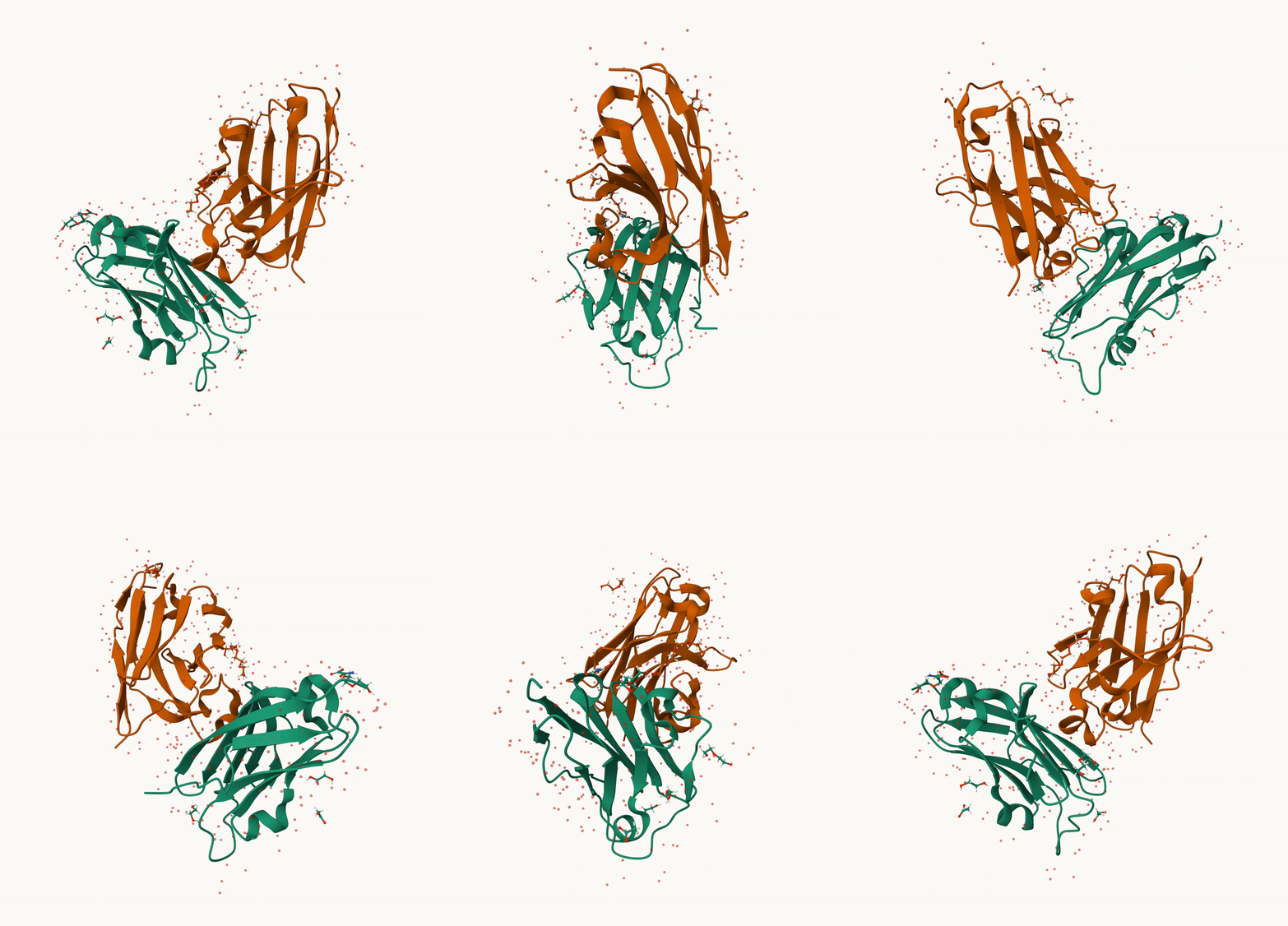
The article reviews an RFantibody workflow for generating VHH nanobodies and scFv antibodies against a specified target structure and epitope. The cited work reports validated examples against influenza, TcdB, and a Phox2b peptide-MHC complex, while noting that initial designs may need affinity optimization.
The pipeline has three stages: RFdiffusion generates an antibody-like backbone around the chosen epitope, ProteinMPNN assigns CDR sequences, and a fine-tuned RoseTTAFold2 model evaluates whether the sequence can recover the intended complex. These computational filters help prioritize candidates but cannot establish binding on their own.
Scale and target choice matter. The article reports a smallest successful set of 95 VHH designs and suggests that substantially larger campaigns may be needed because the available structure model does not cleanly distinguish binders from non-binders. High-throughput experimental screening remains important.
The authors recommend selecting accessible epitopes with suitable hydrophobic contacts and checking a small pilot batch of predicted poses before scaling up. Suggested minimum filters include low predicted alignment error and close agreement between designed and re-predicted structures, while the post emphasizes that passing these filters is not proof of a binder.