Tamarind Blog
Tamarind Blog
Thoughts from the Tamarind team on computational protein design and AI+life sciences

BindCraft2: Day One Access on Tamarind
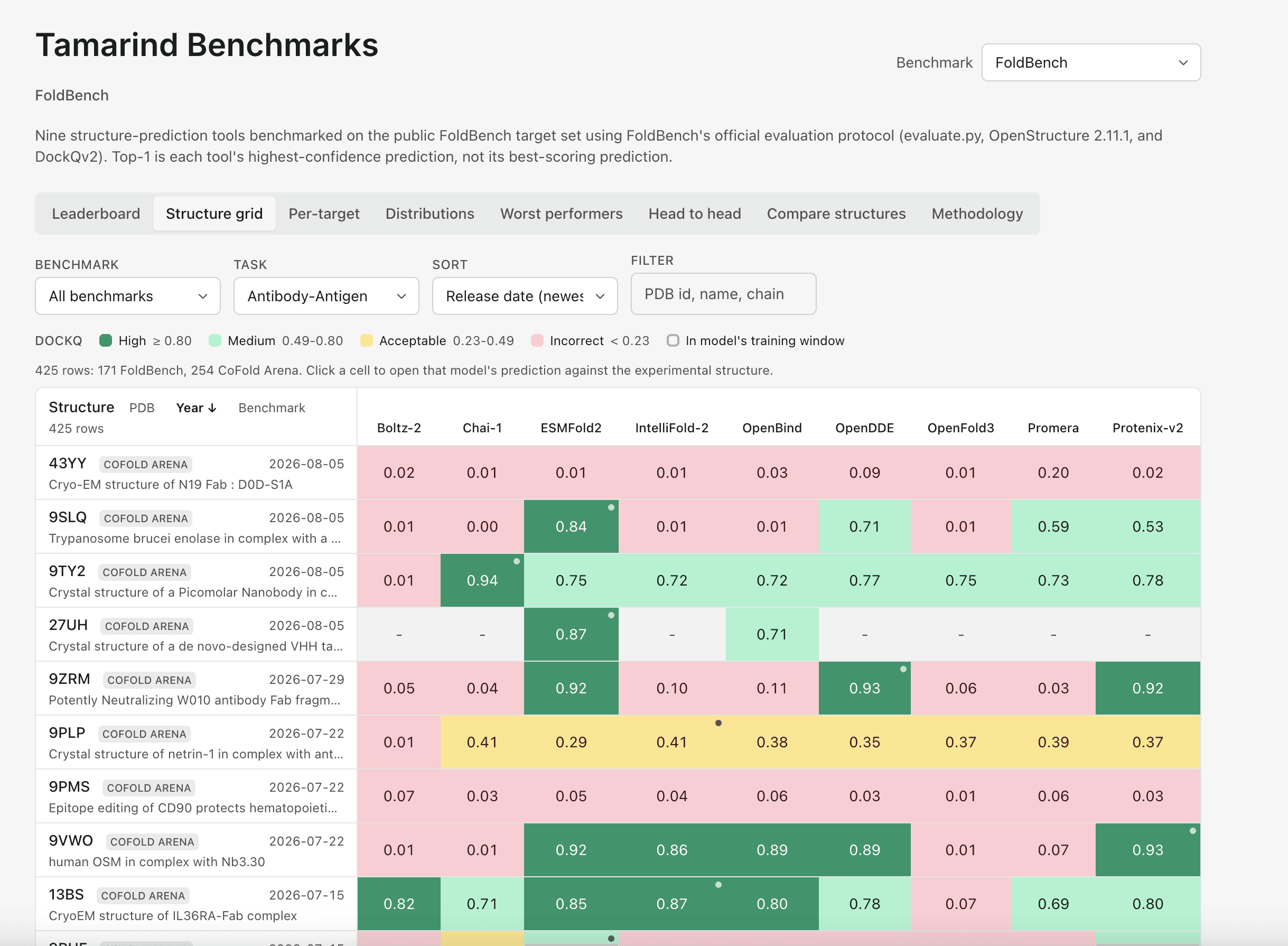
Introducing Tamarind Benchmarks

Introducing the Tamarind Molecular Model Router

Introducing the Tamarind Protein Design Agent

Introducing Pipelines 2.0

The Open Models that Outperform AlphaFold3

Building the Inference Layer for Agentic Biology with NVIDIA

BoltzMol-1, BoltzProt-1, and the Boltz API are live on Tamarind, on day 0

Tamarind Bio Selected by Eli Lilly as Technology Partner for TuneLab2.0

ESMFold2 and ESM-C: A World Model of Protein Biology, Now on Tamarind

Introducing the Tamarind Bio Assay Portal

Introducing the Tamarind MCP Server

Raising $13.6M to Build the Infrastructure for AI-Powered Drug Discovery

BoltzGen: Validated de novo binder design for diverse targets

OpenFold3 and The Future of Protein Folding

Predicting Antibody Properties & Developability

A New Best Structure Prediction Protocol
Commercially available!

A Comprehensive Introduction to AI for Proteins (2026)

Structure Prediction
Boltz-2: State of the Art Structure and Binding Affinity Prediction

Binder Design
Boltzdesign1: Designing De Novo Binders to More Than Just Proteins

Protein Therapeutics
Computational De Novo Design of Antibodies and Nanobodies

Protein Therapeutics
Computational De Novo Miniproteins As Therapeutics
Results for minibinders used as drugs.

Structure Prediction
Chai-1r, AlphaFold3 Level Performance: Now Completely Open Source

Structure Prediction
How to Use AlphaFold3 Commercially

Immune Proteins
How Well Does AlphaFold3 Work for Antibodies and Nanobodies?
AlphaFold3 is by far the current state of the art model for structure prediction, how accurate is it for immune proteins?

Structure Prediction
Boltz-1: AlphaFold3 Level Performance, Truly Open Source and Commercially Available
Researchers from MIT and Genesis Therapeutics announce Boltz-1, a model that achieves AlphaFold3 level sucess in protein, protein-ligand complex structure prediction with no restrictions on use. Here we provide a webserver and API on Tamarind Bio for all to use.

Protein Therapeutics
Are Mini Proteins the Next Antibodies?
Mini proteins have many benefits over traditional protein therapuetic modalities, are they on the rise?

Protein Structure Prediction
Computational PPI Screening
AlphaFold predicts multimer structures well, here's how researchers use it for predicting protein-protein interactions